لطفا منتظر بمانید ...
0% Complete
صفحه اصلی
/
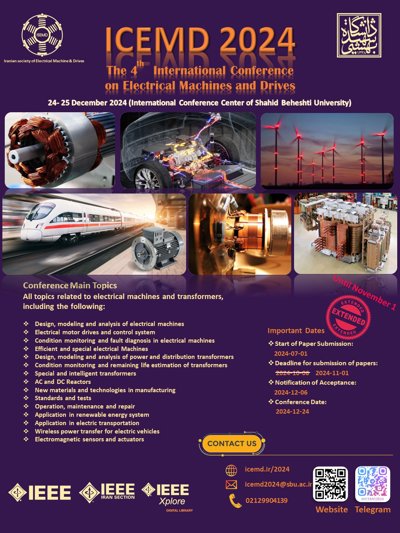
The 4th International Conference on Electrical Machines and Drives
A LCC-LCC Converter with Near Constant Output Voltage for Autonomous Underwater Vehicles
نویسندگان :
Ahmad Siroos
1
Ebrahim Afjei
2
Xiaodong Liang
3
Alireza Sheikhi Fini
4
1- Faculty of Electrical Engineering Shahid Beheshti University Tehran, Iran
2- Faculty of Electrical Engineering Shahid Beheshti University Tehran, Iran
3- Department of Electrical and Computer Engineering, University of Saskatchewan, Saskatoon, Canada
4- Power System Operation and Planning Research Department, Niroo Research Institute, Tehran, Iran
کلمات کلیدی :
Autonomous Underwater Vehicle (AUV)،Electromagnetic Couplers،Finite Element Method (FEM)،LCC-LCC Converter،Wireless Power Transfer (WPT)
چکیده :
Autonomous Underwater Vehicles (AUVs) are increasingly employed for underwater activities. To increase the autonomy range of AUVs, underwater wireless charging techniques for AUVs have been extensively researched recently. In this paper, a novel double-sided LCC converter for wireless power transfer (WPT) in AUVs is proposed that can obtain a good efficiency, and maintain the output voltage and current of a constant resistance load within an ideal range despite momentary changes in the distance between the transmitter and receiver coils due to ocean water turbulences. The passive element values of the proposed compensating converter are defined using the nonlinear optimization method through the software GAMS. The magnetic coupler used in this paper is a 200×200 mm2 plate with a coupling coefficient ranging from 0.08 to 0.9. To validate the proposed method, the system parameters are calculated for the proposed and conventional methods in two scenarios with different voltage and power levels, showing significantly lower voltage variations due to the gap changes between the couplers in the proposed method than that in the conventional method.
لیست مقالات
لیست مقالات بایگانی شده
Analysis of a Toothed Consequent-Pole Flux Reversal Motor with Assisting Permanent Magnets
Mohammad Reza Sarshar - Jamshid Kavianpour - Mohammad Amin Jalali Kondelaji - Mojtaba Mirsalim - Amir Khorsandi
Fuzzy Logic Based Severity Detection of Broken Rotor Bars Using Current and Vibration Analysis
Hamidreza Aghaei - Ebrahim Nikghalb - Omid Khanzadeh
Acoustic Fault Diagnosis of Rolling Bearings in Induction Motors Using Time-Frequency Image Analysis
Erfan Madadi Mahani - Ahmad Mirabadi - Amir Hossein Karamali - Ali Rezazadeh
Pre-Impregnation High Voltage Testing of Random-Wound Stators for Early Detection of Insulation Defects
Ali Alaeddini - Fatemeh Ramezani - Mahdi Khademnahvi - Mansour Torabi
A Comparison Study Between Different Decoupling Circuits & Inverter Models in Induction Drives for FOC
Mohadese Abdol - Jalal Nazarzadeh
Prediction of Transformers Lifespan Under Thermal and Load Stresses Using Machine Learning
Mohsen Naservand - Abolfazl Pirayesh Neghab
Effect of Slot and Pole Combination on the Efficiency of a Permanent Magnet BLDC Motor
Ali Zibarzani - Zahra Nasiri Gheidari
Thermo‑Fluid Feasibility Analysis of Alternator Rotor Winding Replacement via Computational Fluid Dynamics
Omid Mahdavi keshavar - Ehsan Mohammadian - Hadi Zarafshani
Surrogate-Assisted Reliability Analysis of Traction Induction Machine Used for Urban Bus with Reduced Design Parameters
Amir Hossein Hajizamani - Amir Rashidi - Seyed Morteza Saghaian Nejad
A Comparative Study on the Performance of Battery Impedance Models in State-of-Charge Estimation
Mohammad Mahdi Gholami - Alireza Rezazadeh
بیشتر
ثمین همایش، سامانه مدیریت همایش ها و جشنواره ها - نگارش 44.11.0